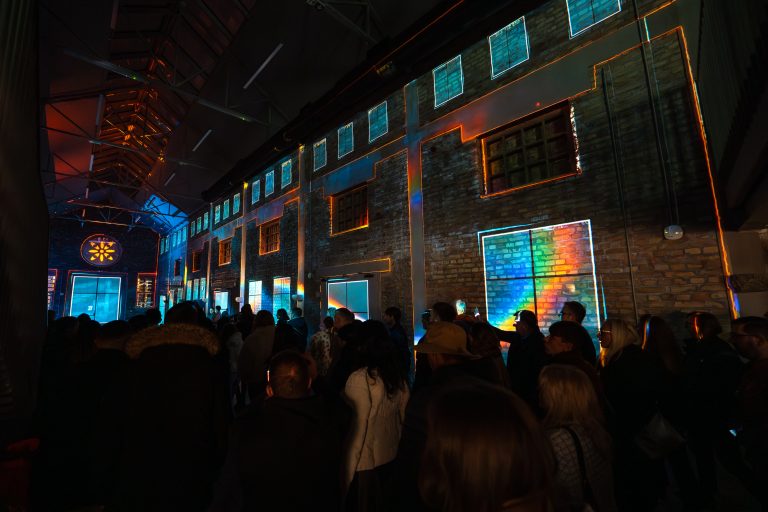
Multimedia artist Tijana Jevrić will present on December 20 and 21, in the newly restored Čeličana in the District, the installation “Decoding Silence”, a unique audio-visual landscape inspired by the inner world of Mileva Marić Einstein. The work is part of the multimedia event “Mileva: Decoding”, with which Novi Sad marks the 150th anniversary of Mileva Marić Einstein’s birth.
The installation, conceived as a kind of mind laboratory, immerses visitors into an environment that reveals Mileva’s curiosity, strength, and the layered silence that surrounded her life. Through light, shadow, sound, and pulsating visual fragments, Jevrić does not recount Mileva’s biography, but opens a space for encountering her intellectual energy and the meanings hidden between the lines.
Tijana Jevrić graduated in New Visual Media at the Academy of Arts in Novi Sad and has since created immersive, site-specific, and audiovisual installations. She has exhibited in Serbia and abroad—from the Museum of Contemporary Art of Vojvodina to the Cultural Center of Serbia in Paris and Ars Electronica in Linz—and her work has been recognized and awarded. In “Decoding Silence”, she encountered Mileva for the first time as an artistic code, and from that dialogue emerged an installation that opens Čeličana as a new center of media art.
In a conversation for Visit Distrikt, she shares how she approached Mileva’s story, the challenges of translating it into sound and light, and what she hopes visitors will feel as they step into this subtle yet powerful space of silence.

What was the first “frequency” that connected you to Mileva’s story?
The first thing that connected me to Mileva’s story was a kind of inner silence I immediately sensed—though not a passive one. Silence as a space where something important is born. As I read about her life, encountered various interpretations, I felt a rhythm vibrating beneath everything we know about her—something like a swarm of bees. As if a deep strength existed that never imposed itself, yet was persistently present. That frequency drew me in: a blend of vulnerability, clarity, and quiet courage. I felt she could only be approached gently, with respect, and that the most important parts of her story were not loud but profound.
In your installation, did you focus more on Mileva as a scientist, a woman, a mother, or an enigma?
I didn’t want to place Mileva into a single role. I worked with her thoughts, inner world, and experiences so the audience could feel both her scientific curiosity and her emotional life—as well as the strength of a woman facing challenges. The focus is more on her internal enigma and process of exploration than on external labels, allowing the viewer to encounter her as a living experience rather than a historical portrait.
What was the hardest aspect of translating her life into an audiovisual language?
The most challenging part was the limited reliable information about Mileva’s life, and I didn’t want to make assumptions or create a literal depiction. I wanted to capture her inner flow—the strength within silence, her curiosity and perseverance; the way she endured restrictions and losses and yet continued to grow. It was particularly demanding to portray her position as a woman in science who, despite her talent and ability, often remained invisible or underestimated.
I thought about how symbolic elements—pulsating light particles, windows with fragments of childhood, moving shadows, floating formulas—could create a space in which the audience senses her inner world. I wanted the installation to function as an experience rather than a factual representation. The focus was on emotion and Mileva’s inner strength, her unseen struggle, and her significance as a woman scientist.
What do you want visitors to take away from encountering your installation?
I want visitors to feel Mileva through rhythm, shadows, and light—her life and inner strength, rather than just facts. To recognize her curiosity, perseverance, and the strength within silence, and perhaps feel encouraged to step courageously through their own challenges.
Did you use any concrete fragments from Mileva’s letters, works, or biographical records as signals for sound or visual narrative?
I used fragments of her letters and biographical notes as inspiration for tone and rhythm—not to depict them literally, but to convey her inner strength and curiosity through sound and light. These signals help the visual narrative “breathe” in harmony with her experience, without becoming a factual illustration.
How did you think about space? Does the installation guide the visitor through a narrative or immerse them in a reflective environment?
I thought of space as a medium in itself. It is both narrative and ambience. It guides the visitor through the flow of Mileva’s inner world, but not in a linear way—rather through experience. The space allows immersion into her thoughts and emotions, shadows and rhythm, so each visitor can create a personal interpretation.
New media can feel cold or abstract. How did you create emotional contact with the audience through digital formats?
New media can indeed feel cold or abstract, but I always try to keep each work alive and connected to the audience through its structure and creation process. Since the development of the work is shaped by the data I collect, I can never know in advance which direction it will take. I consider this the only correct approach to staying true to the idea—every piece of information matters.
At the beginning, I allowed technical questions to influence the idea, which blurred the clarity of the message. Over time, I developed a principle: first research, then gathering, merging, experimenting—experiment, experiment—only then the final form. Through many projects and adapting to different museum-gallery spaces and themes, I learned how to extract the emotional layer from digital work and connect it with the audience.
If you could show your installation to Mileva today, how do you think she would react?
It’s hard to say with certainty, as she was a complex and introspective person, but I’d like to believe she would recognize the sincerity and care with which the work was created. Perhaps she would remain quiet, observing deeply, staying in her inner reflection. I hope she would feel the energy and vibration of her life and work—and perhaps find in that silence a reassurance that her curiosity, strength, and pursuit of knowledge have not been forgotten.
Who is Mileva, in your opinion?
To me, Mileva is above all an explorer of her own inner world and strength. Her story is not just a biographical footnote or a place beside great names, but a journey through curiosity, discipline, and perseverance. She was a woman who wanted to think and understand the world despite external limitations and expectations. Mileva symbolizes a strength that isn’t immediately visible, yet is constant. That inner principle—her pursuit of knowledge and self-understanding—guides my work and the way I tried to portray her through the installation. When I think of her, I feel deep respect and admiration, and that is what I hope visitors will feel as well.
Photo: private archive