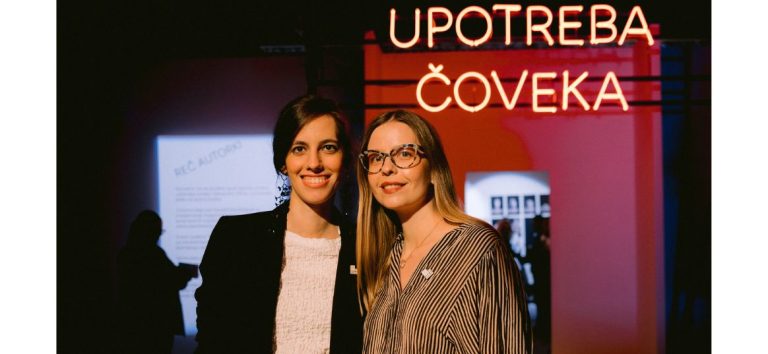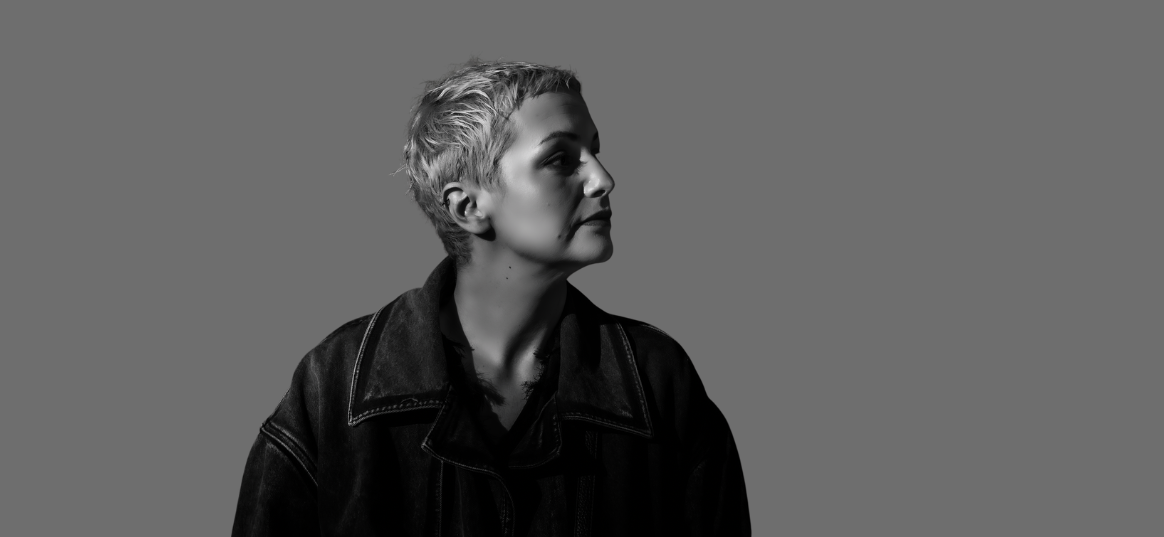
In her work, she dissolves the boundaries between architecture, visual arts, and performing arts, creating exhibitions as spatial installations that are not merely places of observation, but experiences one moves through. Text, scenography, light, sound, video, and objects intertwine in her projects into a single, carefully composed whole. PhD Monika Bilbija studied architecture in Banja Luka, theatre studies in Amsterdam, and the theory of dramatic and audiovisual arts in Belgrade, and earned her doctorate in stage design in Novi Sad. She is a recipient of the Erasmus Mundus scholarship of the European Commission, the author and co-author of numerous exhibitions and cultural projects, as well as the book Film Curatorial Practices: From the Black Box to the Black Box of the White Cube. She is currently completing her second doctoral dissertation in the field of architecture.
Her ability to transform space into a narrative makes her one of the key authors of the multimedia event Mileva: Decoding, with which Novi Sad, as a UNESCO Creative City of Media Arts, marks the 150th anniversary of the birth of Mileva Marić. In one of the largest contemporary exhibition spaces in Serbia—Čeličana, a restored industrial heritage site in Distrikt—more than one hundred participants from eight countries bring together diverse artistic, scientific, and theoretical perspectives. The programme is divided into four segments which, through an interdisciplinary approach, aim to bring the complexity of Mileva’s personality closer to the contemporary viewer and create a space for empathy, understanding, and new interpretations of her significance in our present moment.
When you speak about “decoding” Mileva’s personality, what was the first code you had to break in order to approach her as a human being, rather than as a myth or a symbol?
The first thing I had to do was break the feeling that I “know” who Mileva Marić is. People often believe, based on a few scarce pieces of information, that they have the right to form a judgment about someone’s life, character, or motives. Who is who. What someone is like. And why. I had to discard that illusion—the illusion that we “know” someone we actually do not know—in order to enter the process without prejudice, without ready-made narratives. Only then, when I reduced everything to bare facts, without my own or anyone else’s interpretations, was it possible to approach her as a person, not as a pre-shaped figure from stories told by others. And only then did I arrive at the six key themes around which the exhibition is built.
The exhibition constructs a portrait of Mileva through six themes, moving away from the narrative of either victimhood or heroism. How did you build this new, nuanced portrait?
Instead of placing Mileva once again within biographical frameworks, the intention here was to open a space in which her life can be experienced—as a movement through inner and outer thresholds that shape every human being. Each one of us. The starting point of the exhibition, under the symbolic title Thresholds, was not a reconstruction of her era, but what time does to a person: the pressure of expectations, the weight of decisions, the strength of devotion, the fragility of relationships, the struggle with the body, and ultimately endurance. In that sense, Mileva is a universal figure: a woman balancing genius and social norms, love and work, motherhood and science, dreams and limitations. For that reason, the exhibition does not seek to reconstruct her biography, but to create a space through which the audience moves—through what Mileva carried within herself.
And that space is built in the form of a labyrinth. A labyrinth of six rooms is designed as a topography of inner states—a space in which the wall becomes a metaphor, and the obstacle a way to understand emotion. The walls are intentionally low, only one meter high: the visitor can be seen and sees others through them. This exposure evokes vulnerability, but also the fact that many of Mileva’s struggles took place under the watchful eye of others. Moving through the labyrinth requires bending, crawling, slipping through, climbing—all of which symbolically speak to the effort that remains invisible when we read biographies, yet is deeply felt when life demands perseverance.
In that sense, this is a profoundly architectural exhibition where space, alongside Mileva, is the main character. And that character has its left and right side. On the right side, what is given to us is examined: our body, our character, and will; while on the left are the relationships we form through life—relationships with parents, with children, with partners… The conclusion brings together interdisciplinary voices—psychologists, historians, philosophers, psychotherapists—who help the visitor connect the personal and the universal, the individual and the social. Their interpretations are not judgments, but invitations to reflect.
To what extent do you believe Mileva’s story is universal today? Can a contemporary visitor recognise themselves in her choices, fears, or inner struggles?
The idea I always follow in my work is that I am not someone who speaks from a position of authority, nor someone who offers ultimate truths. I begin from myself, but not from knowledge—rather from emotion. From the question: What can I, as a living being that feels, recognise, understand, and convey to others?
And when I view Mileva in that way—as a person, a living being, a human being in the most essential sense—then the universality of her story becomes unavoidable. Even though we do not share the same life circumstances, bodies, characters, experiences, relationships, or choices, we share inner processes: doubt, fear, anxiety, ambition, pressure, loss, the need for recognition, for love, for freedom. On that level, she is our contemporary.
Thus, a visitor may not recognise themselves in her biography, but I am certain they can—and will—recognise themselves in her struggles. In the feeling of being stretched between expectations and personal desire. In the fear that whatever you do will not be enough, that you are not enough. In the injustice that sometimes overwhelms you. In the effort to remain true to yourself in a world pulling you in every direction. In that sense, Mileva’s story today is not only historical—it is emotionally universal. It is a mirror in which everyone can find at least a shadow of their inner experience.
If Mileva could “enter” your exhibition, what do you think she would appreciate most, and what might she wish to contest?
I believe she would appreciate the space and the place I created. And the fact that it is not a classic gallery setup. This place was made for her, but also for anyone who recognises themselves within it. I think she would value that. I am not certain how much she would like the themes I ultimately chose. Perhaps she would prefer some of them softened, left unsaid, skirted around…
Is there a “void” in her biography that particularly obsessed you—something that cannot be filled, but can be interpreted?
Yes. There is one void that constantly haunts me: the extent to which Mileva contributed to her husband’s work. And not only whether she did, but why it is so important for us to know. That question always brings us back to another, more complicated one: What does success even mean? And how is it measured? By a signature on a scientific paper? Is the value of Mileva’s life measured by the presence of her name in a footnote of the history of science? Or can success be measured differently. By the fact that she was there, that through her work, knowledge, mind, and presence she contributed to the formation of one of the greatest scientific minds of the 20th century. That she gave, even when it was not acknowledged. That she carried, even when it was not seen. Helping others, even when it means placing yourself second, is a profound act—an act of empathy that stands in absolute opposition to narcissism. And in that sense, Mileva is deeply successful to me. Because she succeeded in what is hardest: she succeeded as a human being.
When visitors leave the exhibition, what “code” of Mileva Marić do you hope they take with them, as a personal key for understanding her life—and their own choices?
I think the most important thing the audience can take with them is introspection and reflection. I will consider the exhibition successful if each person, even for a moment, pauses, inhales, exhales, and allows themselves to return to the key moments of their life—to the decisions they made, the ones that shaped them; to the paths they walked, the ones that changed them; to the turning points that directed them. Not to look at their life from the outside, but to feel it again, from within. If you leave the exhibition with the sense that your steps have value—even when they seem small, invisible, or meaningless—that will be enough. Each of us sometimes finds ourselves in despair, in doubt, in the fear that nothing we do makes sense, that it leaves no trace. But if, along your path, you manage to touch even one person, and remain human, true to yourself and your values—your path had meaning. One person is enough. Because we are speaking of a single life, and life, in itself, is a world and is spectacular—especially in those quiet moments in which we manage to touch one another, in which we recognise one another. Those are the moments in which community, friendship, solidarity, empathy are born. The feeling that we are not alone and that meaning often arises precisely in what we offer to others.
Who is Mileva, truly, in your view?
I do not believe anyone can say with certainty who Mileva “truly” is. We can approach her, sense her, attempt to understand her, but we cannot confine her to a single sentence. For me, Mileva is above all a human being. A persistent being full of will, clarity, and courage. Like a flower sprouting from a crack in concrete. A being that carried a great gift and a great burden. A woman who tried to be a scientist, a mother, a partner, and her own person, in a time when even one of those roles was already too much. In my eyes, she is both exceptional and vulnerable; both ambitious and withdrawn; both gentle and unyielding. Someone who wanted much, was capable of much, but found herself in a world that was not ready to receive everything she was. A world that simply was not prepared. And if I had to reduce her to one word, I would reduce her to courage—for her life and her choices required guts. Mileva had guts; she was no coward, and as we know: “cowardice is the most terrible of all vices.”
Author: Milana Milovanov
Photo: private archive